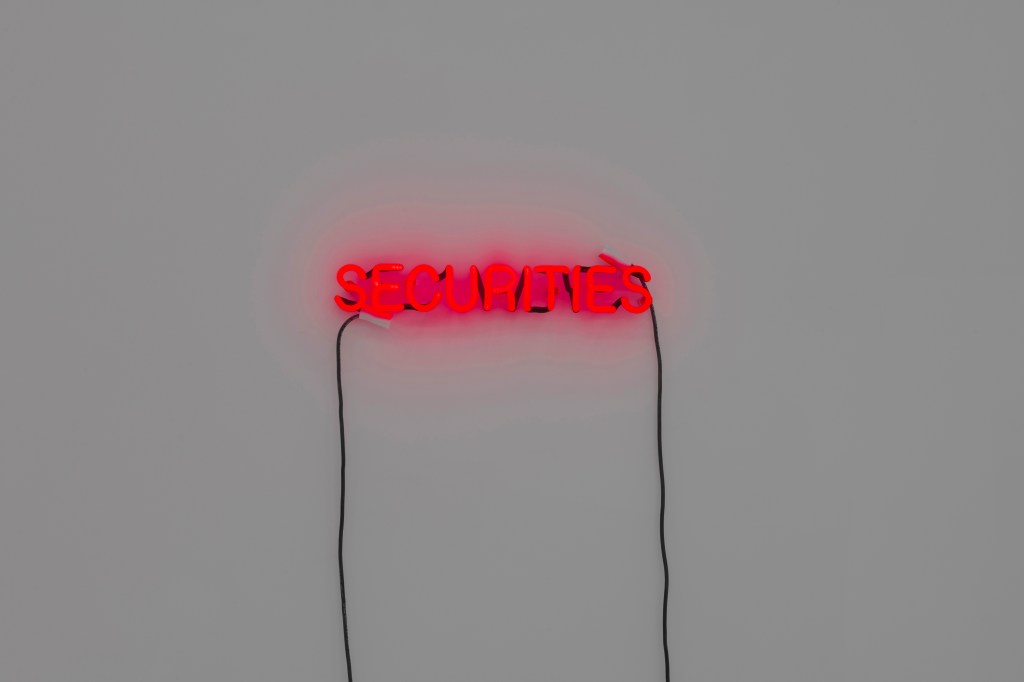
CAPITALISM IN THE PUBLIC REALM – A ruby red neon text sculpture and print series by Anne Katrine Senstad
Money is that materially existing concept, the unitary form or the possibility of all objects of need. By elevating need and work to this level of generality, a vast system of common interest and mutual dependence is formed among great people, a self-propelling life of the dead, which moves hither and thither, blind and elemental, and, like a wild animal, it stands in constant need of being tamed and kept under control
Georg Wilhelm Friedrich Hegel, The Jena lectures 1802-03
The Spectacle is the stage at which the commodity has succeeded in totally colonizing social life. Commodification is not only visible, we no longer see anything else; the world we see is the world of commodity.
Guy Debord: The Society of Spectacle, 1967

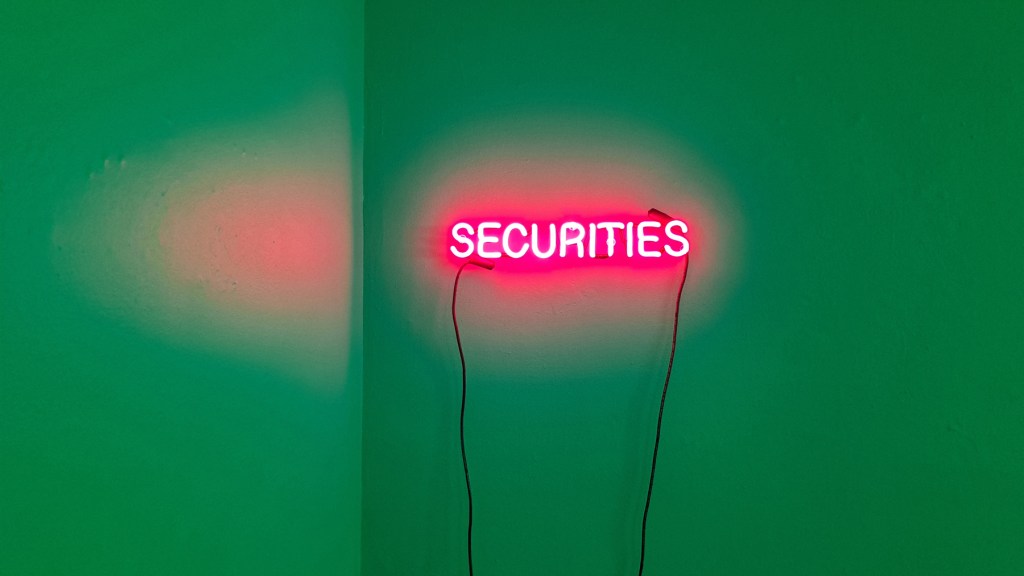
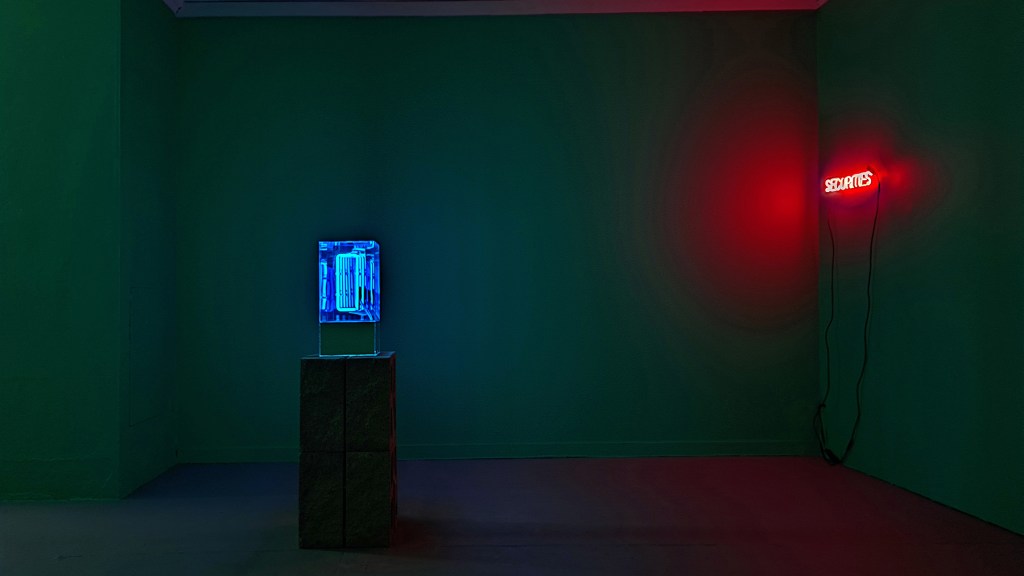
The text statement and light-sculpture SECURITIES plays with finance lingo and the advertising of commerce. Senstad additionally introduces color to her normally white neon texts, and the suggested implications of red. Red being a color of power and state, is also a color of capitalist critique and its denouncement, the color of labor and unity, and also a universal public color signaling danger, alert, and halt.
The ironic usage of red with its serious undertones, reflects Senstad’s ongoing examinations on ethics, societal sustainability and humanism, capitalism and greed, patriarchy and imperialism. The provocativity in the sensorially stimulating and seductive ruby Red neon merged with the iconography of corporate aesthetics, provides a vehicle for reflection through the aesthetics of light, noble gas and color. In the exhibition Mal Educación, the neon text is juxtaposed with teal green, sky and cobalt blue neon, placed on the lush green wall, where the contrasts creates a disturbing distribution of the color spectrum on the retina.
The text work SECURITIES questions the health and future of contemporary social politcal structures and ownership, money and power, investment and finance systems, the erosion of global sustainability, hyper-capitalism and it’s methods of corporatization of political ideologies, land, deregulation and the population of sovereign nations. In utilizing materials such as neon that represents commerce, consumerism, commodification, seduction, culture economy and capitalization of the public realm, the art work references Walter Benjamin’s ideas on Fordism i.e mass production, standardized generic production and evolution of mass consumerism established with the 20th century industrialized world. Senstad emphasizes here the paradox of polarized systems and the place of the individual citizen within the struggle between economies and technologies, public and private ownership of data, autonomy, balance and health, seeking to activate processes of critical thought and response within the individual citizen. Everything is for sale.
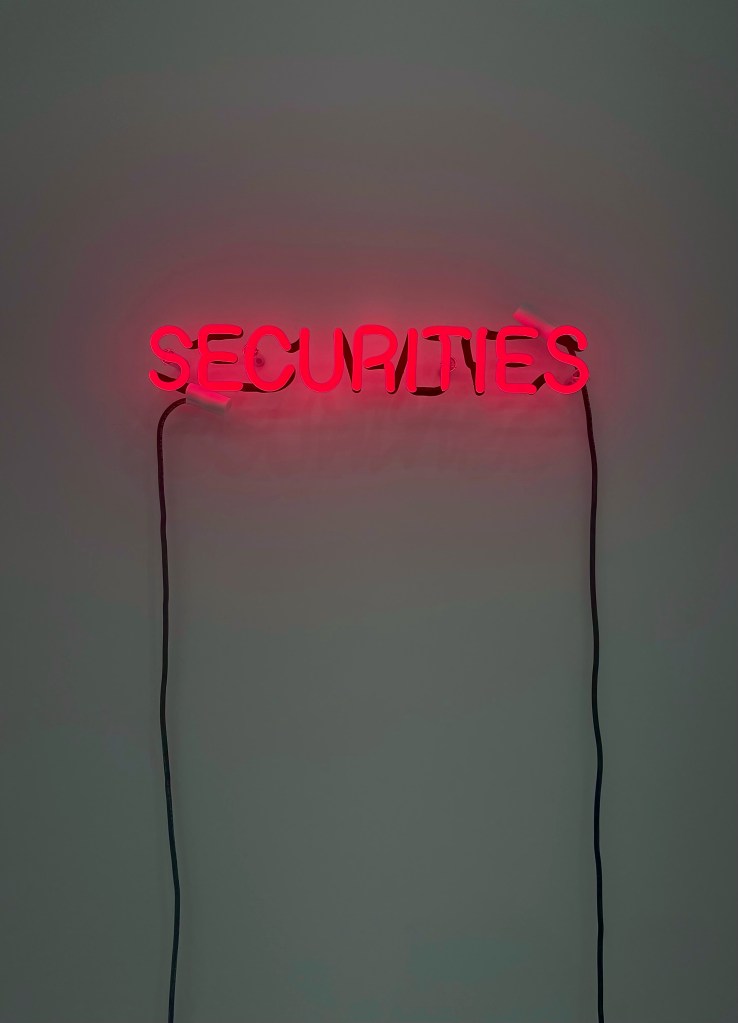
SECURE-TIES/SECURI-TIES

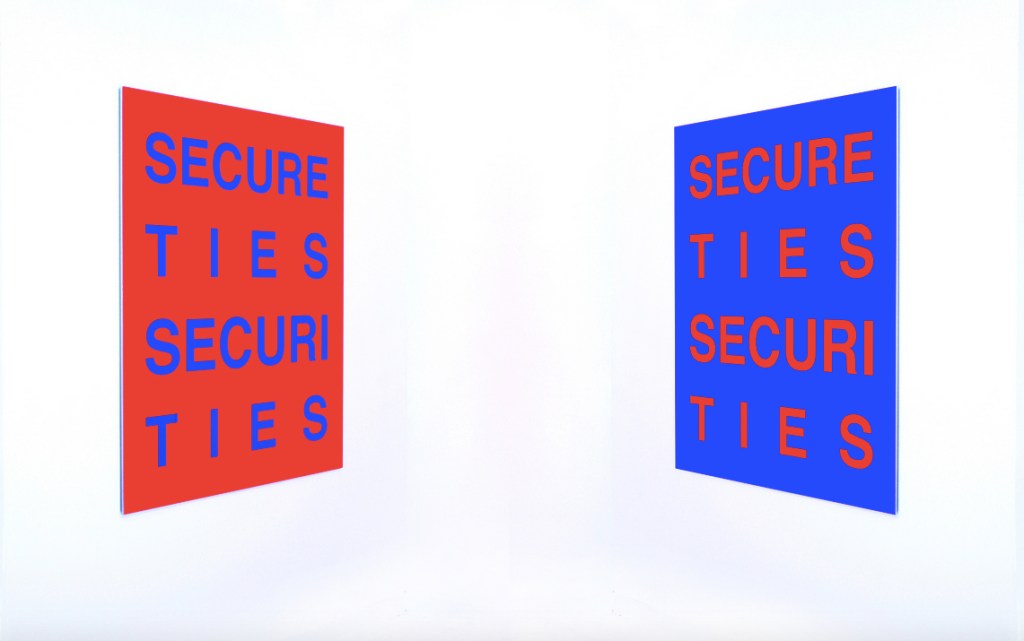
The text statement as a play on words and deconstruction of meaning, mirrors the neon text installation SECURITIES, playing with finance lingo and the advertising of commerce. The suggested implications of red and blue reference corporate aesthetics and political power, advertisement and propaganda, corporate identity and corporate logos such as Bank of America. Red and Blue being a colors of power and state, are also colors of capitalist critique and denouncement of it’s heritage (red). The ironic usage of red and blue with its serious undertones, reflects Senstad’s ongoing examinations on ethics, societal sustainability and humanism, capitalism and greed, patriarchy and imperialism. The visual disturbance in the sensorially overstimulating bright color dialogue in bold Helvetica merged with corporate aesthetics, provides a vehicle for reflection on the power of language, ownership and oppression – simultaneously beautifully subtle and emotively loud in it’s dialogue between red and blue. In dividing the word Securities into two versions: Secure Ties and Securi Ties, implies the dark sides of power. The bond of power over the individual, and power of money over humanity, our future and the planet – and ultimately questions the reality of freedom.
The art work questions the health and future of contemporary social political structures and ownership, the power of money, the erosion of sustainability and infrastructure, hyper-capitalism and it’s methods of corporatization of political ideologies, land, deregulation. In utilizing signage aesthetics and materials such as neon or print, the work represents commerce, consumerism, commodification, seduction, culture economy, harvesting of the public realm. Furthermore, the art work references Walter Benjamin’s ideas on Fordism i.e mass production, standardized generic production and evolution of mass consumerism established with the 20th century industrialized world. Senstad emphasizes here the paradox of polarized systems and the place of the individual citizen within the struggle between economies and technologies, public and private ownership of data, autonomy, balance and health, seeking to activate processes of critical thought and response within the individual citizen. Everything is for sale.
 Capitalism in the Public Realm